
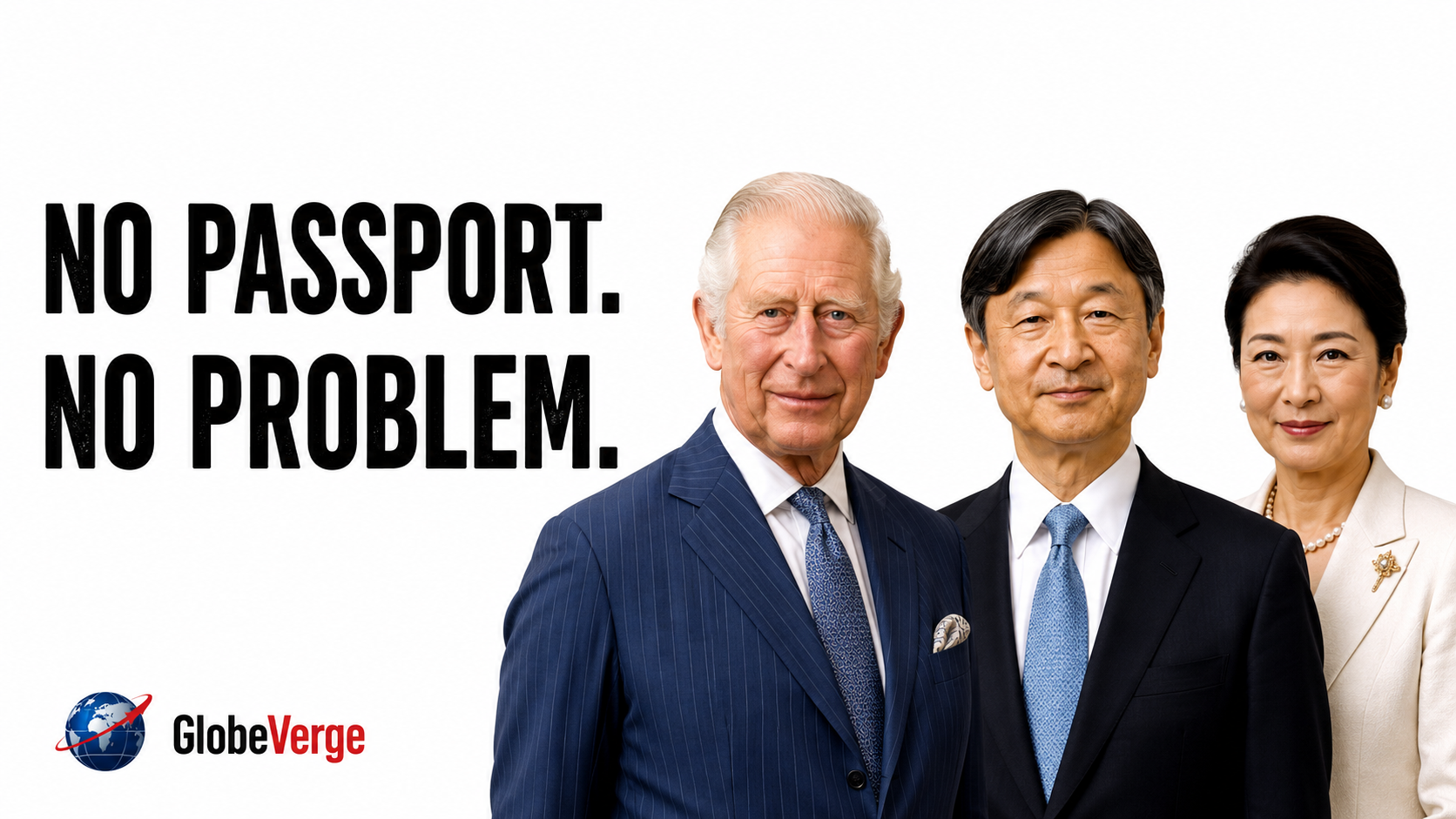
They need passports.
Even the most powerful political leaders normally travel with diplomatic passports when crossing international borders.
But three people stand apart.
King Charles III. Emperor Naruhito. Empress Masako.
Britain’s King does not require a British passport when travelling abroad.
The explanation comes from an unusual constitutional tradition.
British passports are issued under the authority of the Sovereign and formally request, in the King’s name, that the holder be allowed to pass freely and receive assistance when necessary.
In effect, the King would be issuing the document under his own authority.
So he doesn’t have one.
The privilege doesn’t automatically extend through the Royal Family.
Queen Camilla needs a passport. Prince William needs one. Other members of the Royal Family need them too.
Thousands of miles away, Japan has another remarkable exception.
Emperor Naruhito and Empress Masako travel internationally without passports under special arrangements associated with their unique status. Their overseas journeys are coordinated diplomatically between Japan and the countries receiving them.
But there is an important distinction.
No passport does not mean no border control.
King Charles cannot simply arrive unexpectedly in another country and walk through immigration because he is the King. Neither can Japan’s Emperor and Empress.
Countries remain sovereign over their borders.
Official visits involving these figures are arranged government-to-government. Their identities are hardly in doubt, and diplomatic authorities communicate the necessary information before they arrive.
That is what makes their position so unusual.
A president may command a military.
A prime minister may run a government.
A billionaire may own a private jet.
But when they travel internationally, they still generally carry documentation identifying who they are and which country they represent.
For these three, the system works differently.
It is a tiny exception inside an enormous global system of borders, passports, visas and immigration controls—one that most travellers will never encounter.
For billions of people, leaving one country and entering another starts by opening a small booklet.
For three extraordinary travellers, the governments waiting at the other end already know exactly who is coming.