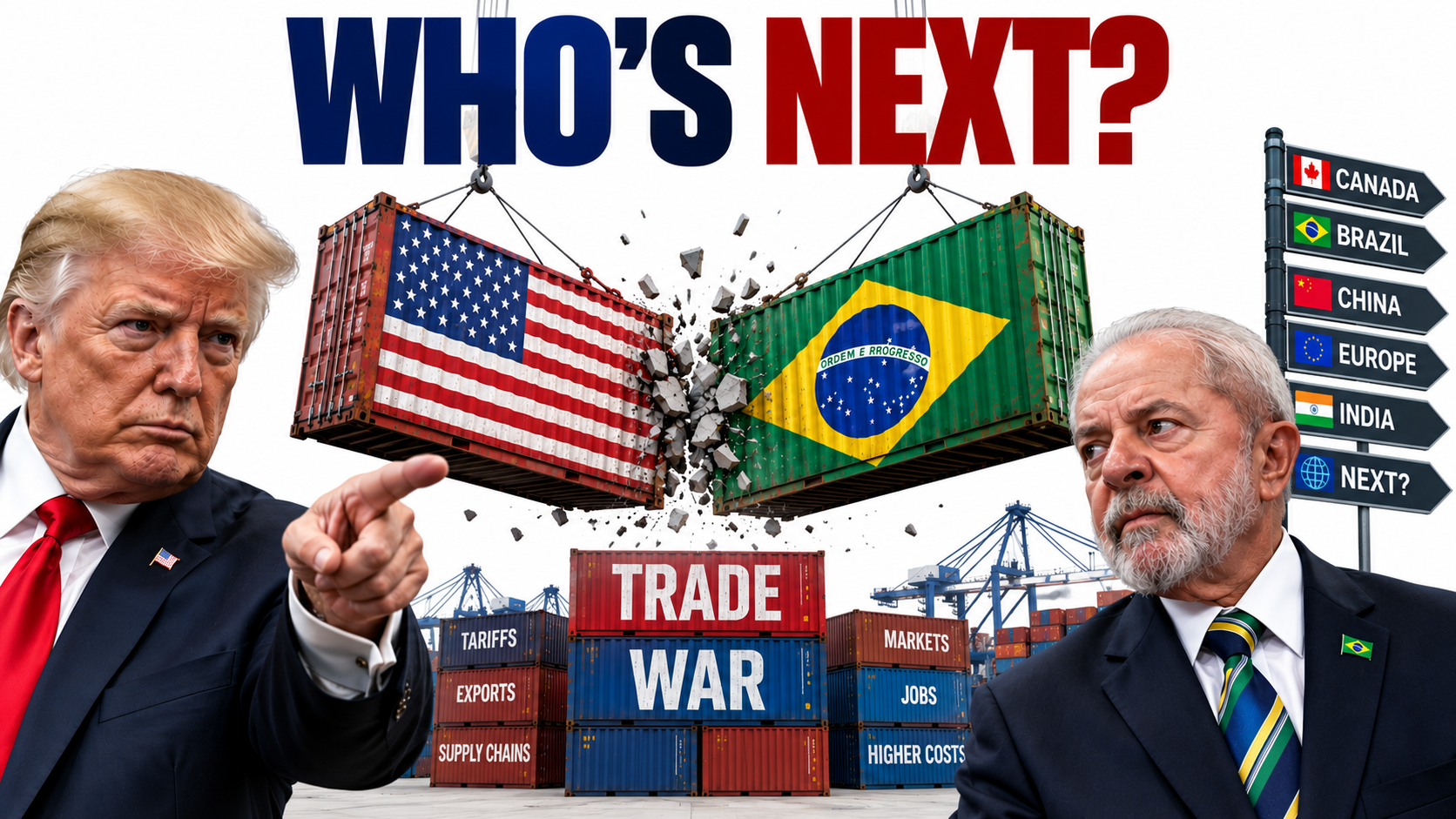
Now Brazil is facing its own version of that problem.
Washington has imposed new tariffs on selected Brazilian products, with some goods facing additional duties as high as 37.5%.
And the effect is beginning to show.
During the first eight months of 2026, Brazilian exports to the United States fell 9.7%, dropping to about $24.1 billion. Among Brazilian products facing the heavier new tariffs, exports have fallen much more sharply.
Wood, tobacco, animal products, stone products, machinery, footwear and other industries are among those feeling the pressure.
But this story is bigger than a few tariff lines.
It raises a question that could become increasingly important across global trade:
What happens when America’s economic pressure encourages its trading partners to become less dependent on America?
Brazil Is Not Canada
Canada’s vulnerability comes partly from geography. Its economy is deeply integrated with the United States, and roughly two-thirds of Canadian exports still head south of the border.
Brazil has considerably more room to maneuver.
The United States is important, particularly as a buyer of Brazilian manufactured goods, but it isn’t Brazil’s largest overall export destination.
That position belongs to China.
Brazil sells China enormous quantities of soybeans, iron ore, oil, meat and other commodities. Meanwhile, its trade relationships with Europe, India and other markets continue to expand.
That gives Brasília something valuable in a trade confrontation:
options.
And Those Options Are Growing
The numbers already reveal an interesting divergence.
Brazilian exports to the United States are down this year, while its overall exports continue to grow.
Exports to China have risen strongly over the year despite a weaker August, while shipments to India have surged and trade with Europe has also expanded.
That doesn’t mean Brazilian companies can simply replace American customers overnight.
Some products are designed specifically for the U.S. market. Supply chains take years to build. Manufacturers can be far more dependent on particular customers than national trade statistics suggest.
But every new tariff gives businesses another reason to ask whether their next factory, contract or customer should depend so heavily on access to the American market.
That is where tariffs can create an unintended consequence.
They can punish today’s trade while changing tomorrow’s trade routes.
Why Washington Is Targeting Brazil
The American argument isn’t simply that Brazil sells too much to the United States.
Washington has challenged Brazilian practices involving digital trade, electronic payments, tariffs, intellectual property, ethanol market access and other areas.
That distinction matters because the United States has historically run a goods trade surplus with Brazil.
This isn’t therefore the familiar story of Washington confronting a country because America buys vastly more from it than it sells.
It is increasingly about something broader:
the rules under which countries do business with the United States.
That potentially makes Brazil an important test case.
The World Is Watching the Pattern
Canada and Brazil are very different economies with very different relationships with Washington.
But there is a common lesson.
For decades, access to the enormous American market was one of the strongest forces pulling countries deeper into U.S.-centred global commerce.
Tariffs change that calculation.
Companies begin diversifying customers.
Governments negotiate new agreements.
Supply chains move.
Countries search for additional payment systems, transportation corridors and investment partners.
None of this happens overnight.
But trade relationships are built over decades—and repeated uncertainty can slowly redirect them.
So Is Brazil Really Next?
In one sense, Brazil isn’t next. It is already in the crosshairs.
The tariffs are operating. Exporters are feeling them. Bilateral trade has weakened.
The real unanswered question is what happens from here.
Washington could negotiate and eventually reduce the pressure.
Brazil could make concessions.
The dispute could stabilise.
Or both sides could harden their positions and push businesses toward alternative markets.