
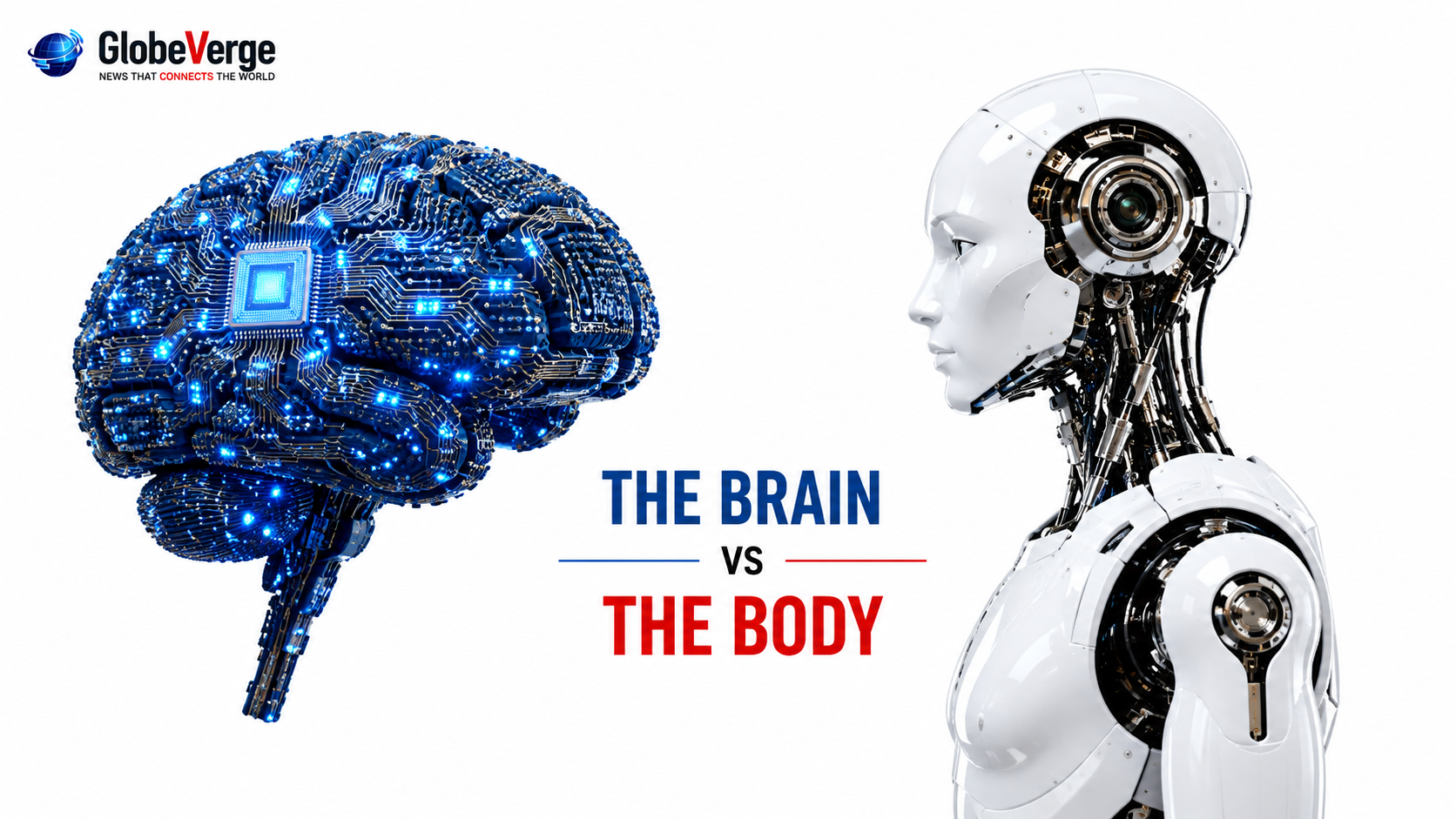
America remains at the centre of the global AI boom. Its technology companies have attracted extraordinary levels of investment, built enormous computing infrastructure and developed some of the world’s most capable artificial-intelligence systems. U.S. private investment in AI reached roughly $286 billion in 2025, compared with around $12 billion in China.
China, however, has another major advantage: the ability to manufacture at enormous scale.
That difference is becoming increasingly visible in robotics.
More than 2,000 robots are participating in Beijing’s latest humanoid-robot competition, taking part in sporting events as well as practical challenges intended to test how machines perform outside controlled laboratory conditions. More than 40% of the competitions involve robots operating autonomously.
Behind the spectacle is a much larger industrial ambition.
China is developing machines that could eventually carry materials in warehouses, assist workers on production lines, inspect equipment and perform repetitive physical jobs. In the longer term, similar machines could find roles in healthcare, retail, agriculture, construction and homes.
China is particularly well positioned to manufacture them.
The country already has vast supply chains producing electric motors, batteries, sensors, electronics and industrial equipment. It is also the world’s largest market for industrial robots and has years of experience automating factories.
The emerging competition is therefore more complicated than simply America versus China.
Both countries are developing AI and both are developing robotics. But their existing strengths create an interesting contrast.
The United States has a formidable ecosystem for developing increasingly sophisticated machine intelligence.
China has a formidable ecosystem for turning technology into physical products and manufacturing them at scale.
The real breakthrough could arrive when those two technological worlds converge.
A powerful AI system sitting inside a data centre can automate parts of office work. Put increasingly capable intelligence inside an affordable physical machine and automation can reach factories, warehouses and other workplaces that still depend heavily on human labour.
That could have consequences far beyond the world’s two largest economies.
For decades, countries have competed for factories partly through the availability and cost of workers. China used that formula to become the world’s manufacturing powerhouse. Vietnam, Mexico and other countries later benefited as companies diversified production.
India wants a larger share of global manufacturing. Southeast Asia continues attracting factories. Latin American economies are competing for supply chains, while several African countries hope industrialization can provide employment for rapidly growing populations.
Affordable intelligent robots could gradually change that calculation.
If a factory can produce the same output with hundreds of machines and a much smaller human workforce, cheap labour becomes less important. Electricity, infrastructure, engineering expertise, capital and access to markets become more important.
For China, there is an intriguing possibility.
The country became an economic superpower partly by building products with an enormous industrial workforce. It could now become a major producer of the machines that reduce industry’s dependence on human workers.
In effect, China would not simply manufacture the world’s products.
It could increasingly manufacture part of the world’s workforce.
That future is still some distance away.
Humanoid robots can perform impressive demonstrations while struggling with ordinary tasks that people barely think about. Handling unfamiliar objects, connecting equipment correctly, adapting to changing surroundings and working reliably for long periods remain difficult engineering problems.
This is why spectacular robot races and demonstrations can be misleading.
The numbers that ultimately matter are much less exciting: price, reliability and productivity.
A robot becomes economically transformative when a factory manager purchases it not because it looks futuristic, but because the machine can perform useful work reliably and its lifetime cost makes financial sense.
Once that calculation begins working at scale, the consequences could spread quickly.
The first phase of generative AI raised questions about programmers, writers, analysts, customer-service employees and other knowledge workers.
Robotics could bring similar questions to physical work.
That makes the U.S.–China technology rivalry increasingly important to countries that are not participating directly in it.
The next great AI breakthrough may not belong simply to whoever develops the smartest model or the most impressive robot.
It may belong to whoever successfully combines intelligence, affordable machines and mass production.
America has extraordinary strength in building the brain.
China has extraordinary strength in building things.
The race now is to see who can connect the two — and make it cheap enough for the rest of the world to buy.