 GlobeVerge
WORLD
GlobeVerge
WORLD
China Sends Trade North, While Hormuz Burns
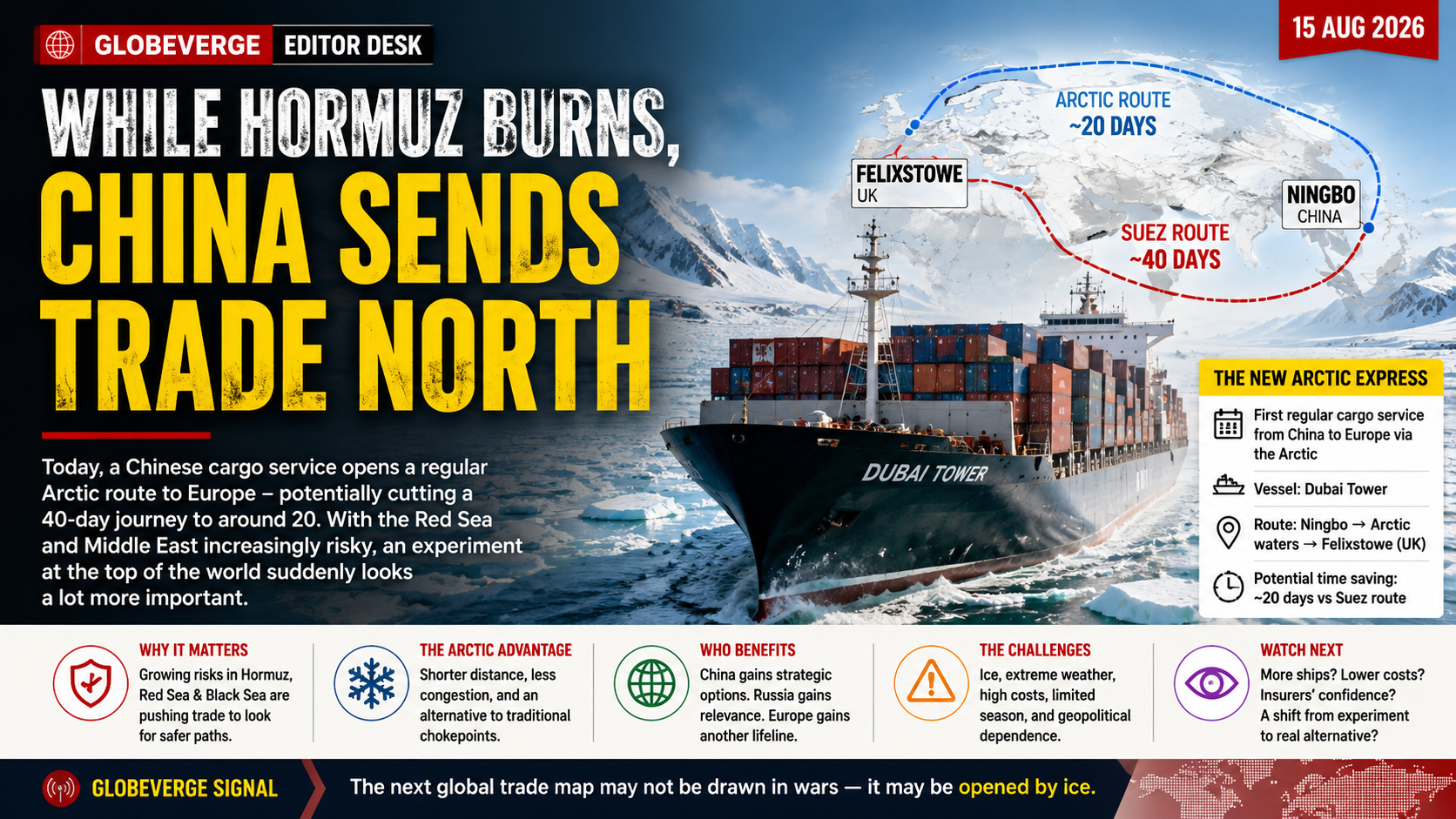
As conflict makes some of the world’s busiest shipping corridors increasingly unpredictable, China is opening a regular Arctic cargo route to Europe. A journey that normally takes around 40 days could fall to roughly 20 — turning a frozen shortcut into a potentially important new trade corridor.
A Chinese shipping company is beginning a regular container service between Ningbo and Felixstowe, travelling along Russia’s northern coast.
Traffic through the Strait of Hormuz has plunged amid continuing hostilities, while years of insecurity around the Red Sea have already forced shipping companies to rethink routes.
For decades, global shipping primarily asked:
What’s the cheapest and fastest route?
The next question may increasingly be:
What’s the safest route when the world’s chokepoints become part of the conflict?
- Why it matters
- The Arctic won’t replace Suez anytime soon. But if Hormuz and the Red Sea remain risky, a difficult northern route suddenly becomes more attractive.
- Most affected
- China — Gains another route to Europe with less dependence on traditional chokepoints. Russia — Its Arctic geography becomes more strategically valuable. Europe & shipping companies — Gain another potential route, but face higher insurance, ice and geopolitical risks.
- Likely next
- More ships — One voyage is an experiment. Regular traffic would be a signal. Insurance costs — They could determine whether the shorter route actually makes economic sense. China’s investment — New ice-capable ships and Arctic infrastructure would suggest this is becoming strategy. The world is watching whether old shipping routes stay open. GlobeVerge is watching where the ships go if they don’t.
More stories
- Vijayanagara celebrates Independence Day with focus on Constitutional values, development
- Leading countries extend greetings to India on 80th Independence Day
- Memorable Independence Day celebrations for students of govt. school at Kade Nandihalli in Shivamogga
- Train passengers to stage stand-up protest in Kozhikode on August 16