
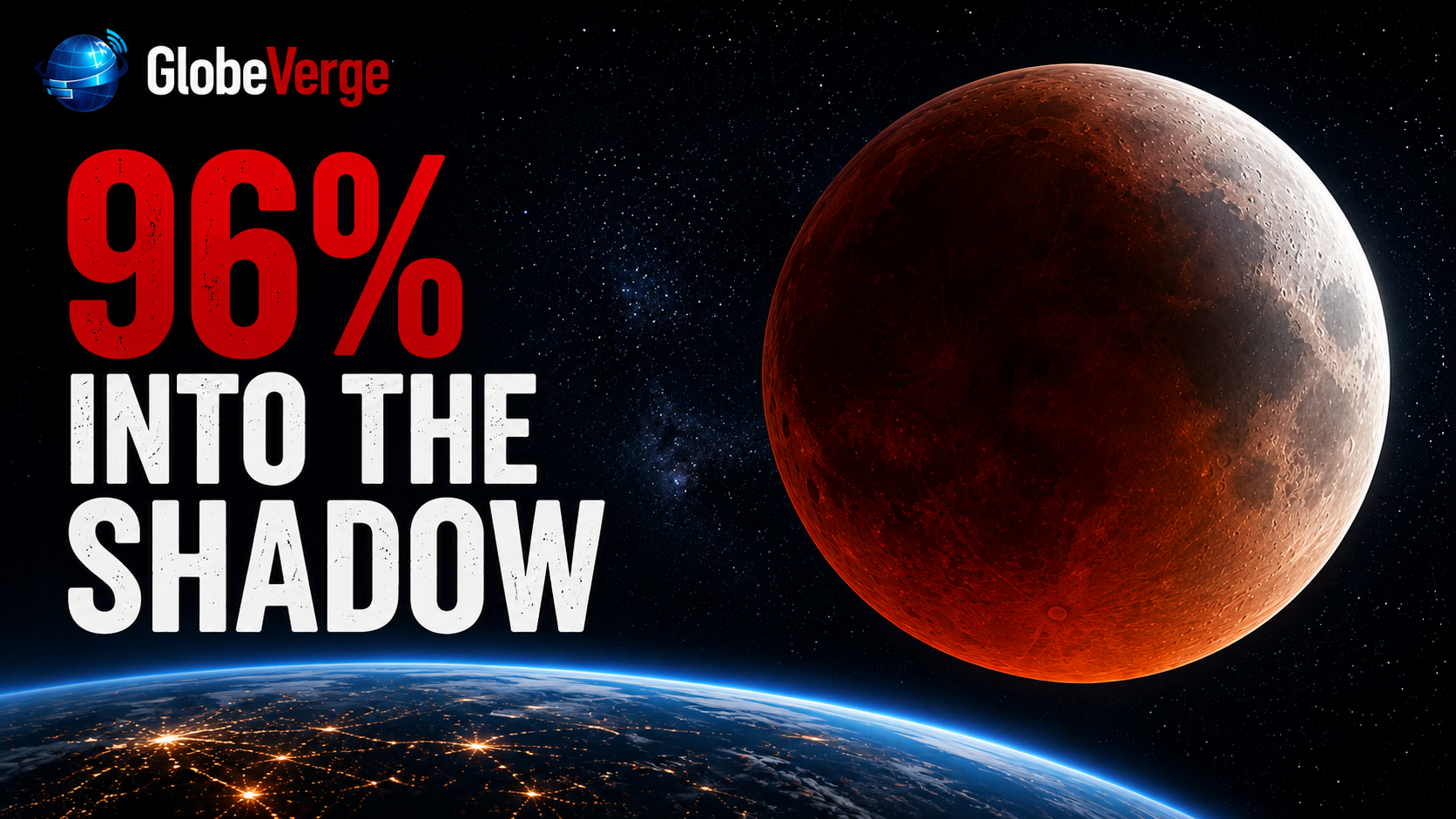
During the August 27–28 lunar eclipse, the Sun, Earth and Moon will move into near alignment, allowing Earth’s shadow to spread across almost the entire lunar surface.
At maximum eclipse, roughly 96% of the Moon will be inside Earth’s umbra, the darkest central portion of our planet’s shadow.
That final few percent makes an important difference.
Because the entire Moon does not enter the umbra, this remains a partial lunar eclipse rather than a total one. Visually, however, it will come extremely close.
As Earth’s shadow advances, most of the bright lunar surface will progressively darken. The deeply eclipsed portion may also develop reddish or copper tones.
The colour comes from sunlight passing through Earth’s atmosphere before reaching the Moon. Much of the shorter-wavelength light is scattered away, while redder light can continue through the atmosphere and bend toward the lunar surface.
In a sense, some of the light reaching the darkened Moon has travelled through the combined glow of sunrises and sunsets occurring around Earth.
But the spectacle will not look the same everywhere.
The eclipse reaches maximum at approximately 04:13 UTC on August 28. Whether someone can see the deepest phase depends entirely on whether the Moon is above their horizon at that moment.
Unlike a solar eclipse, no special eye protection is needed to watch a lunar eclipse.
And perhaps the most remarkable part requires no telescope at all.
A lunar eclipse allows us to watch Earth’s own shadow move across another world.
For a few hours, three objects separated by enormous distances line up closely enough for our planet to block direct sunlight from reaching almost the entire Moon.
No spacecraft creates the spectacle. No technology is required.
Earth simply moves into the right place — and its shadow stretches across space.
This time it will cover roughly 96% of the Moon before retreating again.