
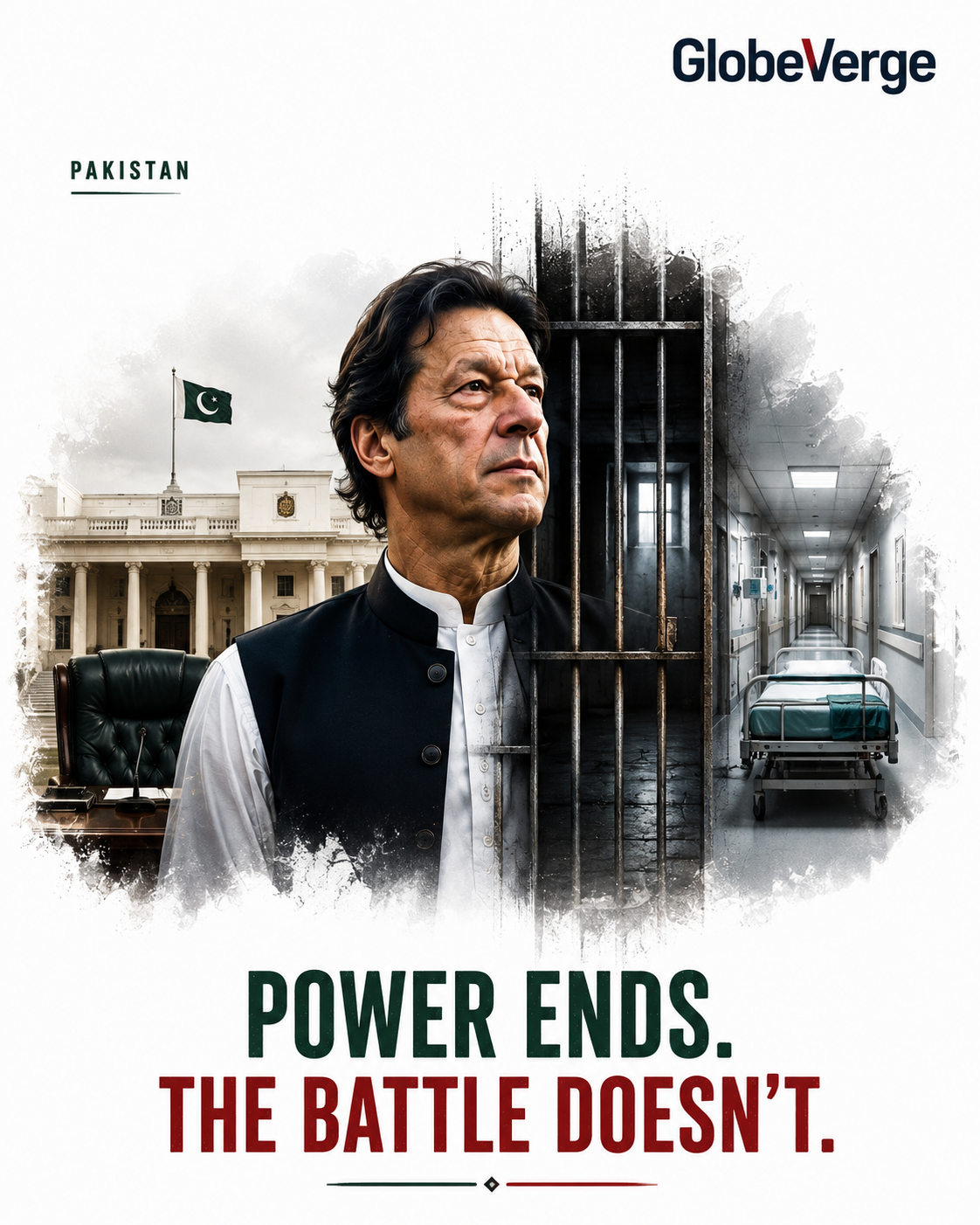
Today, the 73-year-old former prime minister is preparing to leave his prison cell for a hospital after Pakistan’s Supreme Court intervened over concerns surrounding his health.
The court ordered Khan transferred to Shifa International Hospital in Islamabad, where a specialist medical panel, including his personal physician, is expected to oversee his treatment. The intervention follows concerns about problems affecting the vision in his right eye.
For Khan, it is another extraordinary turn in a life that has already travelled from sporting triumph to political power — and then to imprisonment.
Long before politics, Khan was a national sporting icon, captaining Pakistan to victory in the 1992 Cricket World Cup. Decades later, he transformed that popularity into a political movement and became prime minister in 2018.
Four years later, he was gone.
Khan lost office in April 2022 after a parliamentary no-confidence vote. His confrontation with Pakistan’s political establishment intensified afterward, and since 2023 he has remained imprisoned while facing a large number of criminal cases.
He has been convicted in a major corruption case and sentenced to prison, while some other convictions have been suspended or overturned. Khan denies wrongdoing and argues that the cases against him are politically motivated. Pakistan’s authorities and his political opponents reject the claim that he is being persecuted simply for political reasons.
But Khan’s story is difficult to separate from Pakistan’s history.
Since independence, the country has experienced military coups, extended periods of military rule and repeated confrontations between civilian governments, courts and the powerful military establishment.
And one remarkable fact hangs over the country’s political history:
No Pakistani prime minister has completed a full five-year term in office.
- Some were dismissed.
- Some resigned.
- Some were removed by military intervention.
- Some went into exile.
- Some were imprisoned.
- And one — Benazir Bhutto — was assassinated.
Imran Khan therefore represents something larger than another former leader fighting criminal cases.
Despite his imprisonment, his political movement has retained substantial support. Candidates associated with his PTI movement performed strongly in Pakistan’s 2024 election despite extraordinary political and legal pressure surrounding the party.
That leaves Pakistan with an unusual political reality:
A former prime minister remains behind bars — yet remains impossible to remove from the country’s political conversation.
His transfer to hospital may ultimately prove to be nothing more than a medical intervention.
But symbolically, the image is difficult to ignore:
A man who once entered Pakistan’s Prime Minister’s House as one of the country’s most powerful politicians is now leaving a prison cell because the Supreme Court has ordered that he receive hospital treatment.
The courts will ultimately determine Khan’s legal fate.
History will have to answer the larger question:
Is Imran Khan an exceptional political fall — or simply the latest chapter in Pakistan’s extraordinary history of prime ministers who could reach the top but struggled to survive there?