But in many ways, his presidency is.
Midterm elections will determine who controls Congress—and therefore how easily Trump can govern during the remaining two years of his term.
If Americans voted under today’s political conditions, Republicans would enter Election Day in a difficult position.
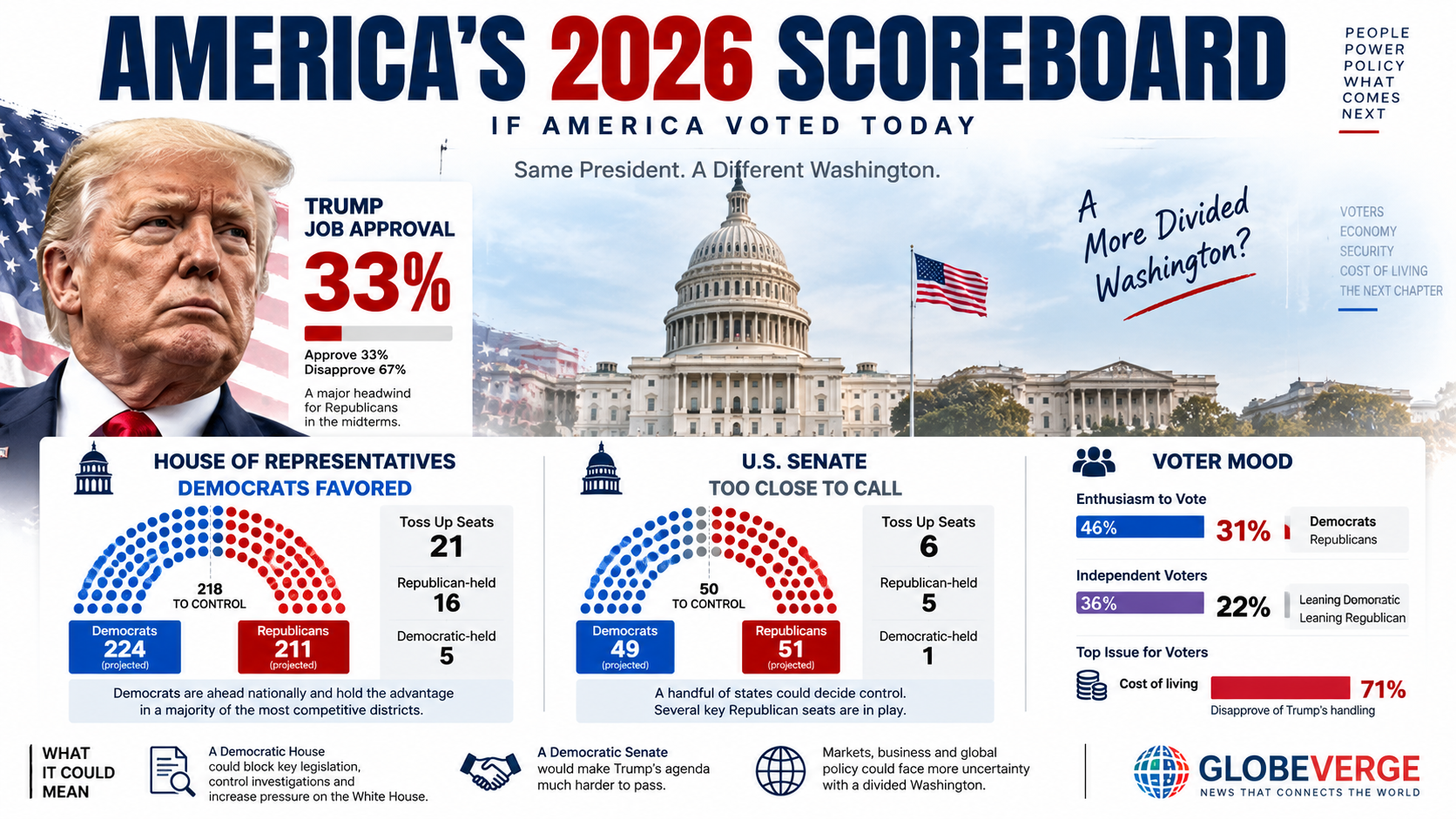
The House appears particularly vulnerable. Democrats are favoured, and many of the country’s most competitive districts are currently defended by Republicans.
The Senate is different. There is no comfortable answer yet. A small collection of highly competitive states could determine control of the chamber, making a movement of only a few percentage points potentially decisive.
The numbers are in our America’s 2026 Scoreboard above.
The more interesting question is:
Why has the battlefield moved this far?
This Election Is Becoming a Referendum on Trump
Presidents don’t appear on midterm ballots, but they frequently dominate them.
Voters dissatisfied with the direction of the country get an opportunity to punish the party controlling Washington without waiting for the next presidential election.
That creates a difficult environment for Republicans.
Trump’s approval has fallen to a level where Republican congressional candidates cannot simply campaign on the popularity of the White House. In competitive districts, some will need voters who may dislike Trump’s performance but still prefer a Republican representative.
That is a much harder political calculation.
The Bigger Warning May Be Enthusiasm
Polls tell us which candidate voters prefer.
Enthusiasm tells us who might actually show up.
Right now, Democrats have a substantial motivation advantage over Republicans.
That matters enormously in a midterm election, where turnout is typically lower than during presidential elections.
A mildly supportive voter who stays home contributes nothing.
A furious voter who waits in line to vote can change a district.
If Democrats maintain their enthusiasm advantage into November, close races could move in their direction even without a dramatic change in national opinion.
Then Come the Independents
The second warning light for Republicans is outside either party.
Independent voters can become decisive precisely where control of Congress is usually determined: competitive suburbs, closely divided states and districts where neither party possesses an overwhelming natural advantage.
Today’s numbers show independents leaning toward Democrats.
That doesn’t guarantee they will vote that way in November.
But combined with the enthusiasm gap, it creates a potentially dangerous equation for Republicans:
less energy inside the party and weaker support outside it.
The Kitchen Table May Decide Congress
For all the arguments over immigration, foreign policy and America’s role in the world, the election could ultimately turn on something much more ordinary.
What does life cost?
Groceries. Rent. Fuel. Electricity. Insurance.
When households feel financially squeezed, economic statistics telling them the economy is performing well don’t necessarily change their experience.
That is why the cost of living remains such an important vulnerability for the party controlling Washington.
Foreign events can also return home through prices. Energy shocks raise transportation costs. Tariffs affect imported goods. Higher inflation can influence interest rates.
What looks like foreign policy in Washington can eventually become a household expense somewhere else.
What Happens If the House Flips?
Trump remains president regardless of what happens in the House.
But his ability to govern could change almost overnight.
A Democratic House could block major parts of the Republican legislative agenda, control congressional committees, intensify investigations and force negotiations over spending and other legislation.
Washington would move from unified Republican control toward divided government.
If Democrats also captured the Senate, the transformation would be considerably larger.
The White House would remain powerful, particularly through executive authority and foreign policy.
But passing major legislation would become much harder.
The final two years of Trump’s presidency could therefore become less about what he wants to enact and more about what he can get through Congress.
November Is Still a Long Way Away
There is an important reason to call this a snapshot rather than a prediction.
Political environments can change quickly.
Economic conditions can improve. Voter enthusiasm can shift. Campaign spending can reshape individual races. Candidates can make mistakes. International events can suddenly dominate public attention.
And Republicans still have time—and enormous political resources—to fight back.
The Senate in particular remains too competitive to treat today’s picture as an election result.
But if we temporarily move Election Day forward and ask what would happen if America voted today, the answer is becoming increasingly clear.
Republicans would be fighting to save the House.
They would be fighting to protect the Senate.
And Donald Trump would be watching an election in which his own name isn’t printed on the ballot—but the power of his presidency effectively is.