 GlobeVerge
WORLD
GlobeVerge
WORLD
Putin’s Next Gamble? The Attack That Could Test Whether NATO Is Really NATO
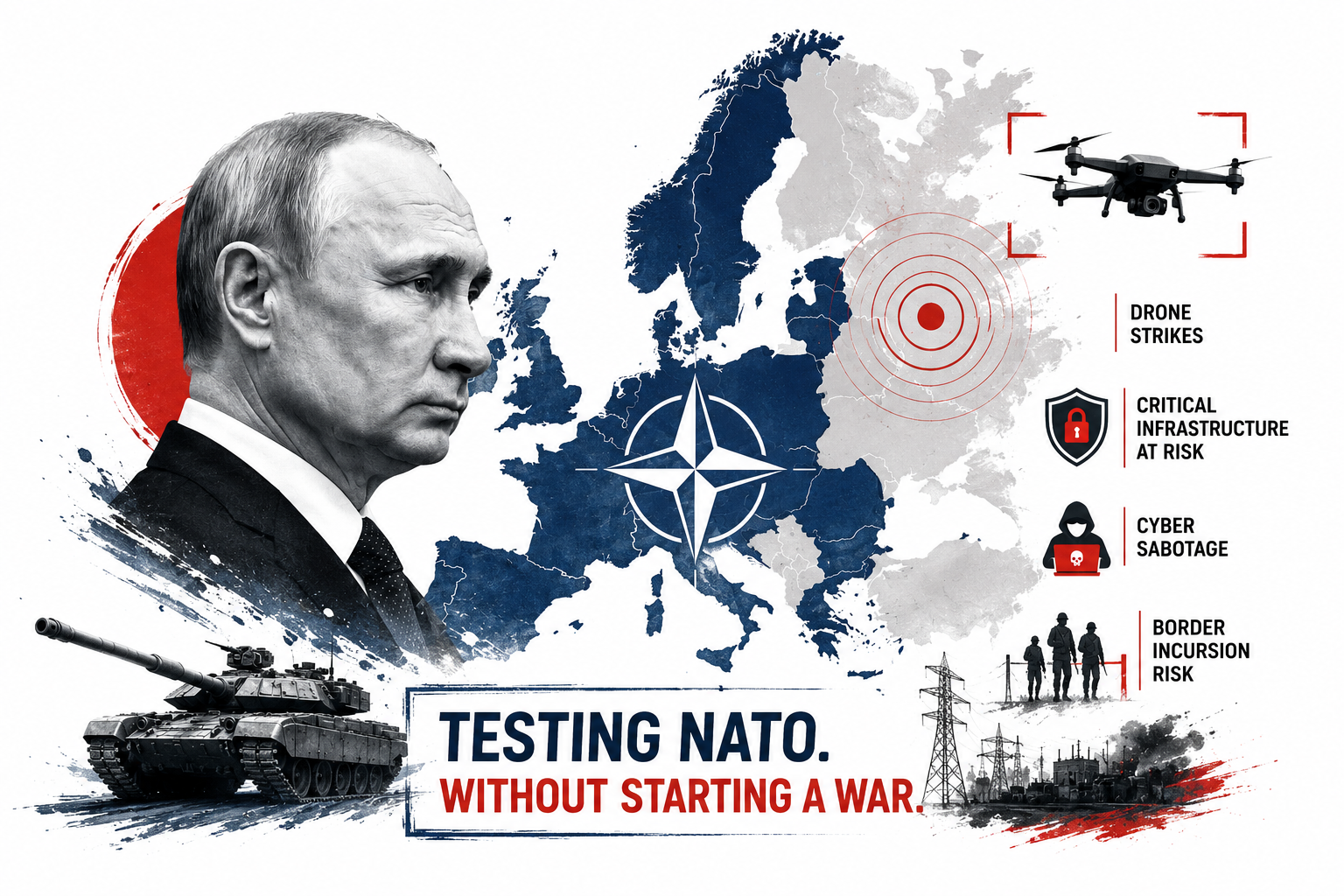
The nightmare scenario may not be Russian tanks rolling across Europe. It could be something much smaller — a drone strike, sabotage, cyberattack or brief border incursion designed to create one dangerous question: Will NATO really respond?
Western security concerns are increasingly focused on the possibility that Russia could eventually test NATO with a limited action against one of its members, rather than launching a conventional invasion.
The objective may not be territory. It could be to exploit uncertainty.
An unidentified drone hits critical infrastructure. A power network suddenly fails. Armed forces briefly cross a border. Evidence pointing toward Moscow remains unclear.
Each scenario creates the same dilemma:
At what point does provocation become an attack on NATO?
Poland and the Baltic states are strengthening protection around critical infrastructure as concerns over sabotage, drones and other hybrid operations grow.
Russia denies accusations that it is preparing attacks against NATO, while the alliance continues to insist that its collective-defence commitment remains firm.
The biggest danger therefore may not be that Putin wants a full-scale war with NATO.It is whether Moscow believes NATO can be challenged without triggering one.
- Why it matters
- A small, ambiguous attack could test NATO unity without immediately starting a conventional war.
- Most affected
- Poland and the Baltic states on NATO’s eastern frontier.
- Likely next
- Unexplained drones, sabotage, border incidents and any change in NATO’s military posture.