Borders matter. Sovereignty matters. International law matters. Governments are expected to respect the independence of other governments.
Then there is the world as it actually operates.
Look at Venezuela.
Earlier this year, the United States carried out a military operation that removed Nicolás Maduro from power and brought him to the United States. Washington subsequently became deeply involved in Venezuela’s oil trade, with Venezuelan oil revenues passing through accounts controlled by the United States.
Now the relationship has moved dramatically further.
President Donald Trump says the United States has secured majority control over more than 65 billion barrels of Venezuela’s proven oil reserves, working through a partnership with private business.
American companies are expected to gain new opportunities to explore and produce oil from strategic Venezuelan fields. Washington sees the arrangement as a way to secure additional crude, attract enormous private investment and potentially put downward pressure on American fuel prices.
Venezuela’s interim government sees another side of the bargain: foreign capital capable of rebuilding an oil industry that possesses extraordinary resources but has suffered from years of underinvestment and declining infrastructure.
It can therefore be described as a deal.
But step backwards and look at the sequence of events.
A superpower removed the leader of another sovereign country. Months later, it is negotiating extraordinary influence over one of that country’s most valuable natural resources.
Whether one views that as intervention, strategic necessity, economic reconstruction or raw power depends heavily on where one stands.
And Venezuela is only one piece of a much larger picture.
Russia invaded Ukraine.
Western governments responded with sanctions, weapons for Ukraine, diplomatic isolation and enormous economic pressure.
Yet Russia continues fighting.
Why?
Part of the answer is power.
Russia possesses nuclear weapons, enormous natural resources, military capability and enough geopolitical weight that confronting it directly carries risks very different from confronting a smaller country.
Then consider China.
Washington can impose tariffs, technology restrictions and sanctions. But China possesses something few countries have ever possessed at its scale: the ability to impose meaningful economic costs in return.
Its manufacturing ecosystem touches almost every major economy. Its companies dominate portions of critical supply chains. Its enormous domestic market gives foreign businesses reasons to remain engaged.
America can pressure China. China can pressure America back.
That ability to withstand pressure may be one of the clearest dividing lines between ordinary countries and great powers.
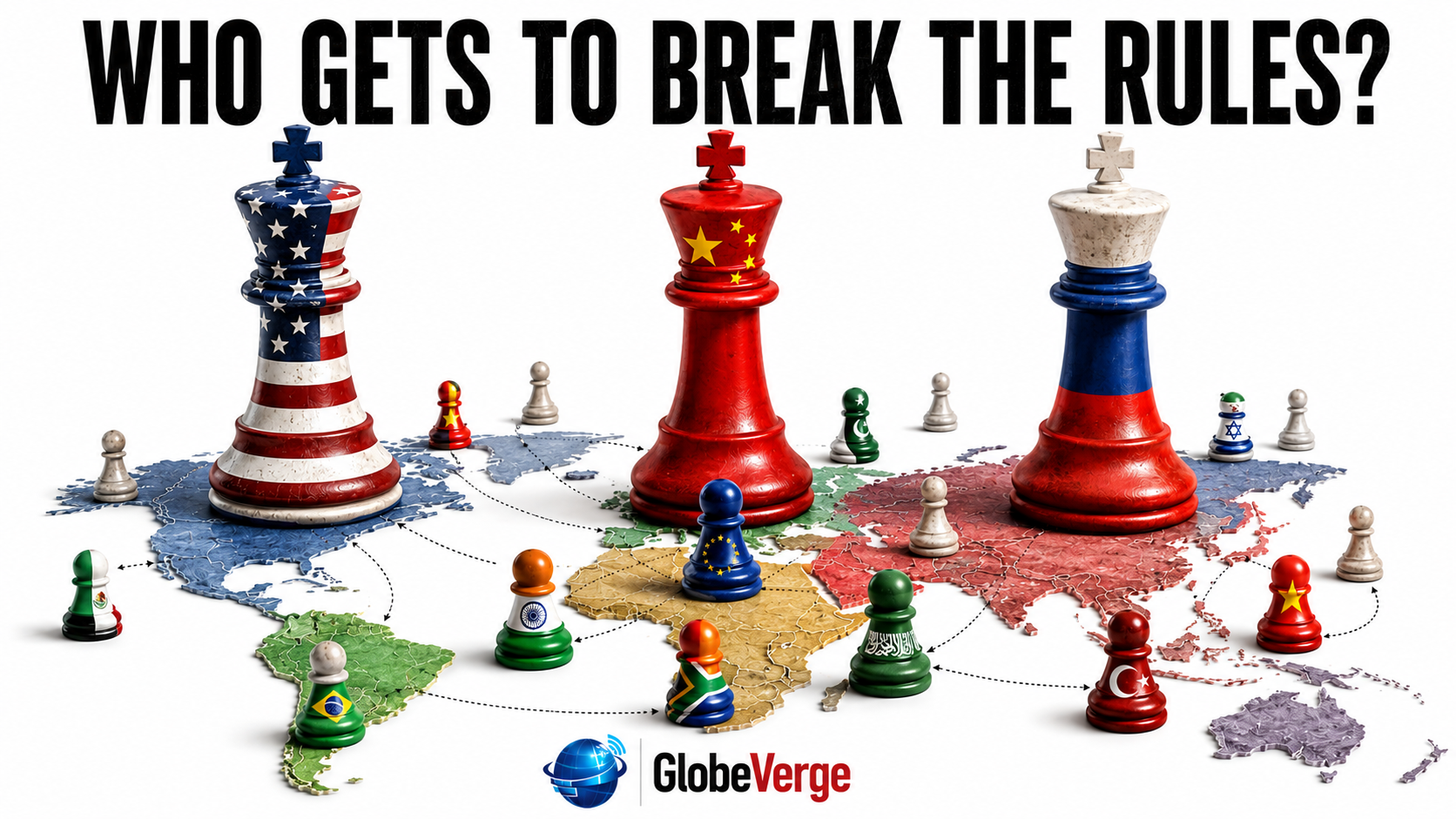
Then come the countries in between.
India can deepen its strategic relationship with Washington while maintaining relationships with Russia.
Saudi Arabia and the Gulf states can maintain American security relationships while expanding business with China.
Turkey can remain inside NATO while pursuing policies that do not always align with Washington.
Countries across Asia, Africa, Latin America and the Middle East increasingly try to maintain relationships with several competing powers simultaneously.
They aren’t necessarily followers.
But they also don’t possess equal freedom of action.
A smaller country violating the interests of a great power may face sanctions, financial isolation, diplomatic pressure or—in extreme circumstances—military intervention.
A great power doing something similar presents the world with a completely different calculation.
That is the uncomfortable hierarchy beneath international politics.
There are countries capable of enforcing rules.
There are countries powerful enough to resist those rules.
And there are countries that must calculate carefully which rules they can afford to challenge.
The Venezuela oil agreement makes that hierarchy unusually visible.
Nearly 200 sovereign countries appear on the world map.
They have flags. Governments. Borders. Votes at the United Nations.
But sovereignty on paper and power in practice have never been exactly the same thing.
Perhaps the emerging world order isn’t really about who follows the rules.
It is increasingly about who possesses enough power to choose when the rules apply.