
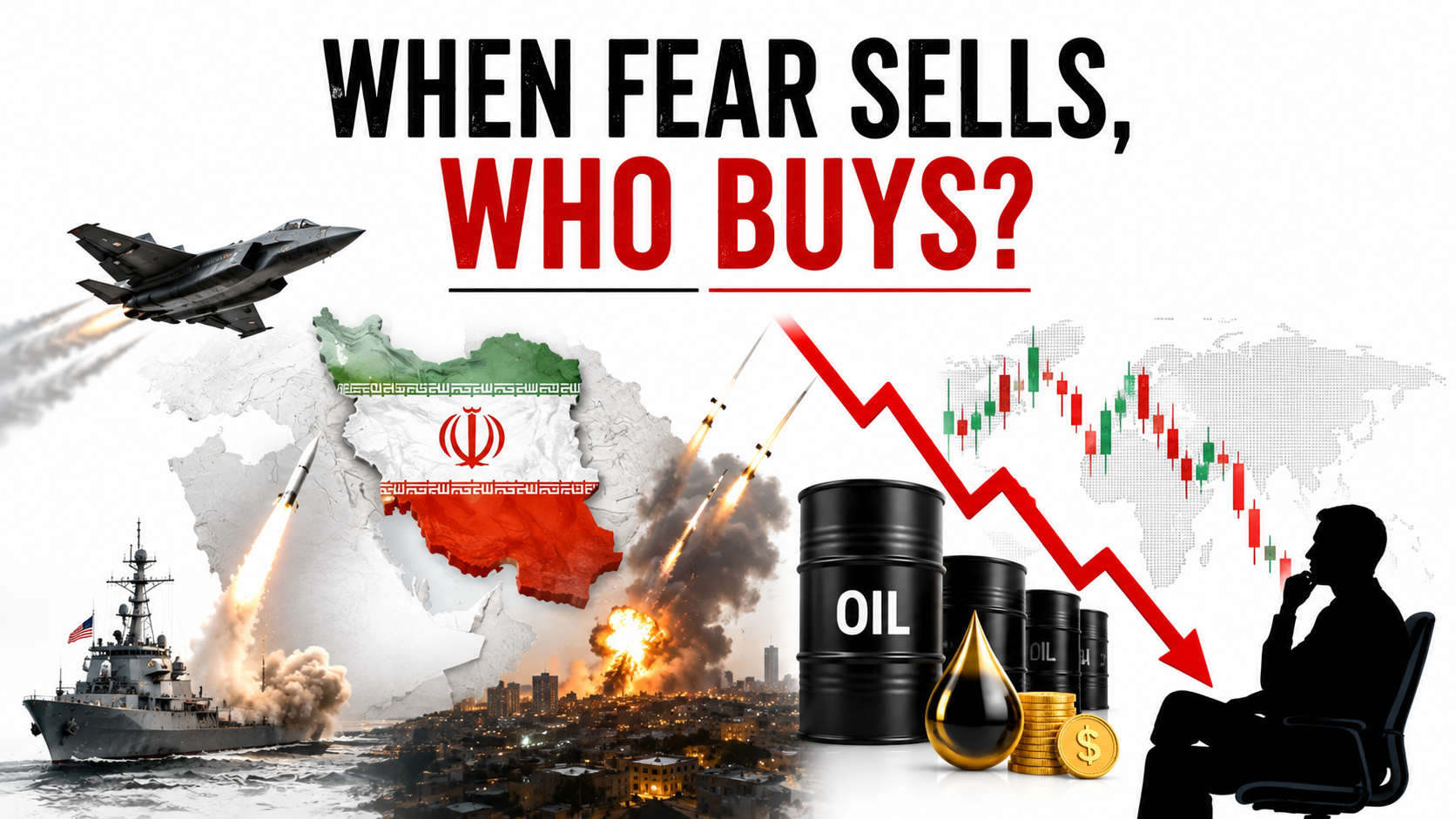
And markets are doing exactly what markets normally do when geopolitical risk suddenly returns.
Oil up. Stocks down. Fear up.
U.S. forces struck Iranian rocket launchers on Larak Island near the Strait of Hormuz on Sunday, ending roughly a month without confirmed American strikes inside Iran.
Tehran responded.
Iranian missiles were subsequently launched toward U.S. positions in Jordan, adding another chapter to a conflict that has now repeatedly moved between escalation and uneasy pauses.
Markets didn’t wait for politicians to explain what comes next.
Oil surged as trading reopened.
Asian equities fell.
Investors once again began pricing the possibility that disruption around the Strait of Hormuz could threaten one of the world’s most important energy routes.
But investors face another question.
What if this keeps happening?
Not peace.
Not all-out regional war.
But a prolonged cycle:
Attack. Retaliation. Fear. Market fall. Pause. Recovery. Repeat.
If that becomes the pattern, the investment implications become very different.
FEAR CHANGES PRICES FASTER THAN BUSINESSES
A geopolitical shock can erase billions of dollars from stock-market valuations within hours.
But the underlying businesses don’t necessarily deteriorate at the same speed.
A profitable bank doesn’t suddenly lose all its customers because missiles were launched thousands of kilometres away.
A technology company doesn’t instantly stop selling software.
A consumer company doesn’t necessarily lose its brands.
A manufacturer with a strong balance sheet doesn’t become a bad company simply because investors become frightened.
Yet their share prices can fall with everything else.
That distinction matters.
A falling share price and a deteriorating business are not always the same thing.
For long-term investors holding cash, repeated geopolitical sell-offs can therefore create something that rarely appears during euphoric markets:
better entry prices into businesses they already wanted to own.
BUT DON’T BUY THE WAR. BUY THE BUSINESS.
This is where investors need discipline.
A market decline alone doesn’t make every stock cheap.
Companies heavily exposed to fuel costs, weak balance sheets or vulnerable industries can genuinely suffer if oil remains expensive.
And a limited confrontation can always become something much worse.
The Strait of Hormuz remains crucial.
A severe interruption to energy shipments could push oil dramatically higher, increase inflation and hurt economies dependent on imported energy.
That would no longer be a temporary market scare.
It could become an economic shock.
So the opportunity isn’t simply:
Stocks fell → Buy.
It is:
Fear pushed a strong business below the price you were previously willing to pay → Take another look.
BUILD THE SHOPPING LIST BEFORE THE PANIC
That may be the most useful strategy during an unpredictable geopolitical period.
Don’t wait for markets to collapse before deciding what you want.
Identify financially strong companies.
Understand their earnings.
Look at debt.
Study cash generation.
Decide what valuation would make them attractive.
Then wait.
Because if the U.S.-Iran conflict continues oscillating between confrontation and temporary calm, volatility itself may become one of the defining characteristics of markets.
The investor who reacts emotionally to every missile risks repeatedly selling into fear and buying back after calm returns.
The investor with a prepared watchlist has another option.
Let fear bring the price to them.
Nobody knows whether today’s confrontation will fade, continue or escalate dramatically.
That uncertainty deserves respect.
But markets have always contained uncertainty.
For investors with long horizons, strong businesses and available cash, the question isn’t simply whether the next headline will be frightening.
It is whether the frightening headline creates a price worth considering.
War creates risk.
Fear creates volatility.
And occasionally, volatility creates opportunity.