
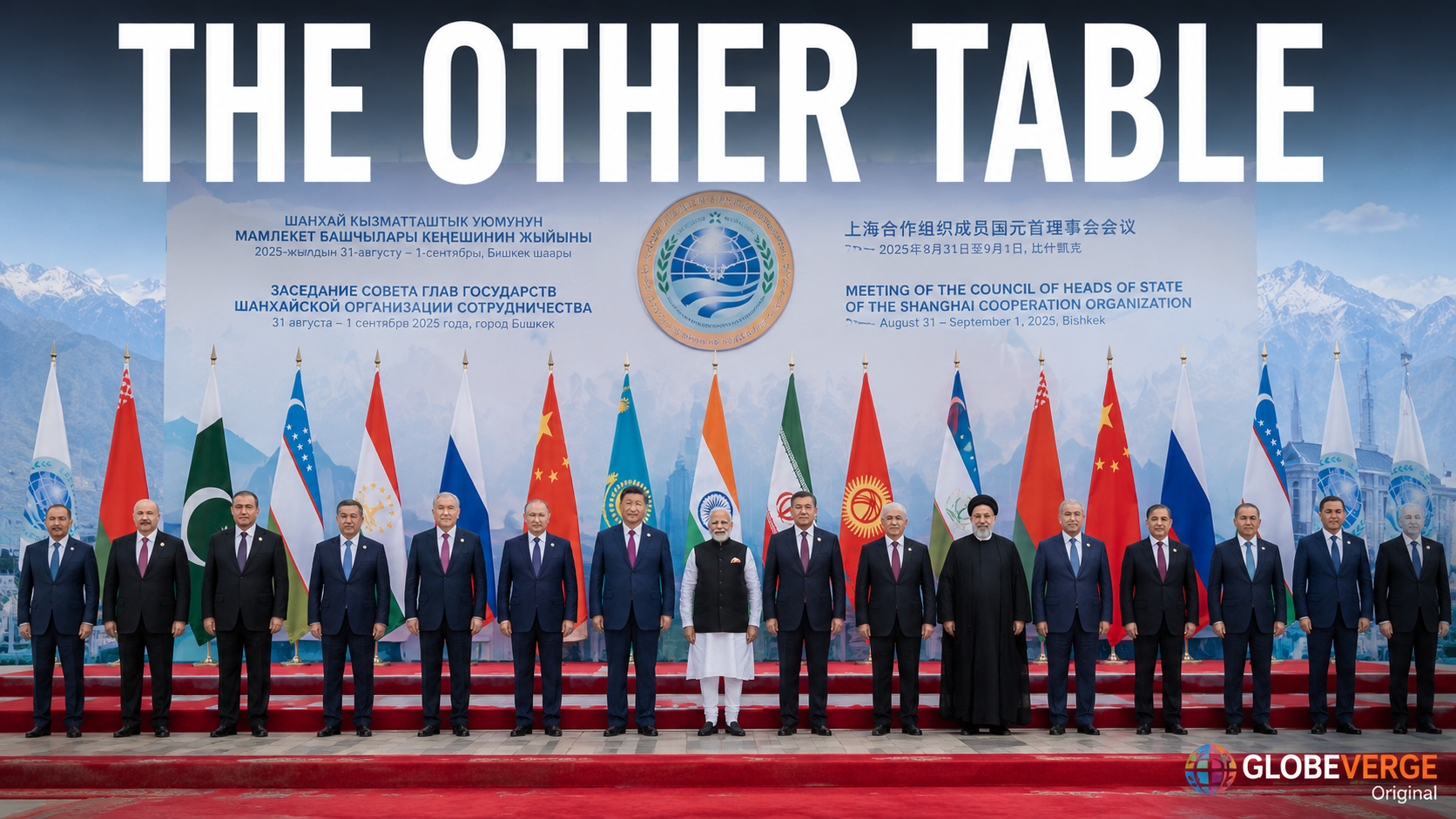
But the environment around the organization has changed dramatically.
Energy security matters more. Trade routes have become strategic assets. Artificial intelligence and computing infrastructure are becoming instruments of national power. Currencies and payment systems increasingly carry geopolitical importance.
Most importantly, governments have discovered how quickly dependence can become vulnerability.
The SCO brings together China, India, Russia, Iran, Pakistan and much of Central Asia, spanning an enormous part of Eurasia and representing more than 40% of the world’s population.
What makes the organization increasingly relevant is that its discussions are moving beyond traditional security. Members are looking at how money moves, how goods travel, where energy comes from and how technology infrastructure can be developed across the region.
Money Is Becoming Strategic
The dollar remains overwhelmingly important to international commerce, but SCO members are exploring greater use of their own currencies when trading with one another.
This isn’t about replacing the dollar tomorrow. The significance is more practical: countries increasingly value having additional ways to conduct business when sanctions, financial restrictions or political disputes complicate traditional channels.
More ways to pay means fewer points of dependence.
Energy Is About Reliability
The same shift is happening with energy.
Price will always matter, but governments increasingly care about whether supplies will remain available during a crisis. A disruption in one important energy region can quickly raise transportation and manufacturing costs, increase inflation and shake financial markets around the world.
That makes cooperation between major energy producers and consumers strategically important far beyond the SCO itself.
Trade Routes Become Insurance
The organization is also pushing deeper connections between roads, railways, ports and logistics networks across Eurasia.
These projects may sound less dramatic than geopolitical summits, but their value becomes obvious during disruption.
When the main shipping route works, an alternative can look unnecessary. When that route suddenly becomes unavailable, the alternative can become extraordinarily valuable.
Redundancy is becoming economic insurance.
Technology Joins the Equation
Artificial intelligence, computing capacity, data infrastructure and digital cooperation are also becoming part of the SCO’s ambitions.
That matters because computing power is increasingly strategic infrastructure. AI requires chips, electricity, data centres, technology and enormous investment.
Countries that depend entirely on outside technology can become vulnerable when export controls or political disputes intervene. Developing additional technological capabilities therefore fits the same broader strategy appearing across energy, finance and transportation.
This Is Not an Eastern NATO
It would be misleading to describe the SCO simply as an anti-Western alliance.
Its members have significant differences. India and China compete strategically. India and Pakistan have longstanding disputes. Central Asian countries pursue their own interests, while Russia, China and Iran have priorities that frequently differ.
But they don’t need to agree on everything to cooperate.
A railway doesn’t require identical foreign policies. An energy agreement doesn’t require a military alliance. A payment mechanism doesn’t require political friendship.
They only need enough common interest to make cooperation worthwhile.
And increasingly, that common interest is having another option—another supplier, another transport route, another market, another payment mechanism or another technology partner.
The Real Test Comes Next
The SCO’s ambitions still face a major challenge: turning agreements into functioning infrastructure.
Plans for deeper financial cooperation and a possible development bank will be particularly important. Railways, energy networks, data centres and industrial projects require enormous amounts of capital.
That is why implementation matters much more than declarations.
If national-currency trade grows, transport corridors expand, technology infrastructure develops and substantial financing follows, the SCO could evolve into something considerably more influential than a diplomatic forum.
Why the SCO Matters Now
For decades, globalization rewarded maximum efficiency: find the cheapest supplier, use the fastest route and manufacture wherever costs are lowest.
Today’s world increasingly rewards resilience alongside efficiency.
Governments and businesses are asking what happens if an energy supplier disappears, a shipping route closes, technology access is restricted or financial channels become caught in geopolitical confrontation.
The answer increasingly appears to be to create alternatives before they are desperately needed.
That is the bigger significance of the SCO.
It doesn’t have to replace the existing international system. Its members don’t have to become allies, and they don’t need to create an entirely separate world economy.
They simply need to create enough alternatives that dependence on any single system becomes less absolute.
In an increasingly unpredictable world, having another option is becoming a form of power.